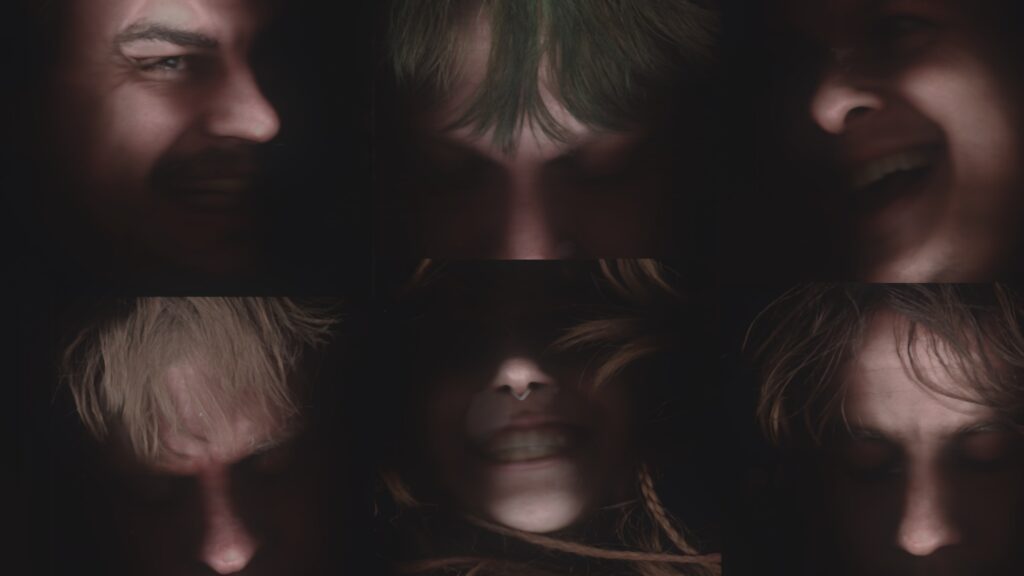
Swedish experimental trio Den Der Hale arrives at Močvara on April 27th. Ahead of their show, we spoke with them about touring, curiosity, custom-built instruments, and turning noise into something new.
You’ve experimented with custom-built instruments and unconventional recording techniques. How were those ideas even born?
It always starts out by being an experiment, springing from sheer curiosity. The sounds these experiments emit creates a guiding hand in our song writing process. It’s also a nice, clean, tactile hobby.
Due to lack of money and the exorbitant price of musical equipment it has always made more sense to us to build them ourselves. There may be flaws and weird noises but those should be embraced.
Pastoral Light has this nature theme, but the sound itself seems distorted and processed. Was that contrast something you were going for, or did it just happen?
A lot of the process behind Pastoral Light revolved around the interplay of nature and industry, metal and wood. This was reflected in the use of electronic sounds, the use of metal plates, traditional rock instrumentation, and the natural timbres of acoustic instruments. The album became an intuitive extension of the lyrical themes surrounding natural forces, seen and unseen.
The first record and Pastoral Light feel connected, but also different somehow: what changed for you between those two?
During Pastoral Light, we wanted to explore the use of textures to a larger extent than we had done during Harsyra. We became more focused on the shapes and textures of the sound rather than the melodic content. Sometimes a melodic line can act restrictive on the ability to intuitively ride different musical dynamics. As we developed as a band this was in line with wanting to become more cohesive live, and creating large movements through the use of volume alone.
Thinking back to when you first started playing together, what’s something you believed about the band back then that you’ve completely changed your mind about?
Probably the idea that there’s an inherent quality about a certain group of people playing music together and that any other constellation wouldn’t be conducive to creating the same sound. After having gone through line up changes and collaborated with other bands (in particular Tren Né, which Mattias and Philip are also members of) we have found that shared music is good music. Having new perspectives on the writing process and being able to work with different people can really act as a fast-track to musical development.
When people interpret your music in ways you didn’t expect at all do you like that, or does it ever feel like they missed the point?
Sometimes it can be pretty surprising being interpreted in ways you never would have thought of. However, any time an artist uses overt symbolism that is too easily interpreted and on the nose it feels like an infantilization of the audience. Art is a collaboration between performer and audience so trying to control peoples’ interpretations of music feels like a vain endeavor.
If someone who’s never heard you before asks “what should I listen for?” – what would you tell them to pay attention to?
Being on the perceiving end of music and art without a carved out receptive pathway can be among the most freeing ways to interpret and feel into someone else’s work as it gives you the space to co-create through free association.
We’d like to give them as much freedom to feel and interpret in a way that flows organically for whomever chooses to listen without us choosing it for them.
Have you noticed differences in how audiences in smaller or less central touring cities respond compared to major cultural hubs? Did anything surprise you?
What we have usually noticed is that in smaller towns the crowd tends to be more mixed age-wise, and that the musical event can feel more ‘important’ than it would have in a larger hub. Same goes for shows with a lesser crowd, the connection can feel more personal and deep when you’re only one of a few people to have seen a show you really like. This is just some general statements and doesn’t exactly reflect all situations.
There’s also the aspect of keeping a music scene alive and thriving. It requires effort by participation. People who live in bigger cities are usually more spoiled with what their city has to offer in terms of cultural happenings.
Can you recall a specific connection, whether with another band, a promoter, or an audience, that only happened because you were touring internationally?
We’ve had the privilege to cross paths with some incredible and inspiring people and audiences along the way, oftentimes through very fleeting moments, but other times moments that have lingered and developed into great friendships. Shoutout to Matías Acuña, Ania Fichera and Alex Carlevaris.
Touring across Europe is often idealised as freedom and discovery but what has actually been the most difficult part of moving your music across borders?
A sharp and dividing line has been drawn out between us and the Royal Princess of Orange as her emergence brought our recent show in Amsterdam to an early end. Oftentimes difficulty and discovery seem to intertwine in quite interesting ways. We do our best to embrace whatever appears and disappears before us.
For someone coming to see you for the first time in Zagreb: what should they expect, or maybe not expect?
Expect nothing, worship everything.
Razgovarala: Anita Ulovec (Volontiram u Močvari)